

AI learns from the wrong data
We spent a decade cleaning operational systems for humans. Now AI needs the mess we filtered out.

I still remember being offshore, staring at a screen insisting everything was fine.
We were running a difficult completion job. Thousands of feet of steel going into a well that was already over-pressured and unpredictable. The kind of operation where everyone on the rig floor starts paying closer attention to small things. A pressure fluctuation that feels slightly off. A vibration you cannot fully explain yet. The tone of someone’s voice changing over the radio.
On the monitor, though, everything looked beautiful.
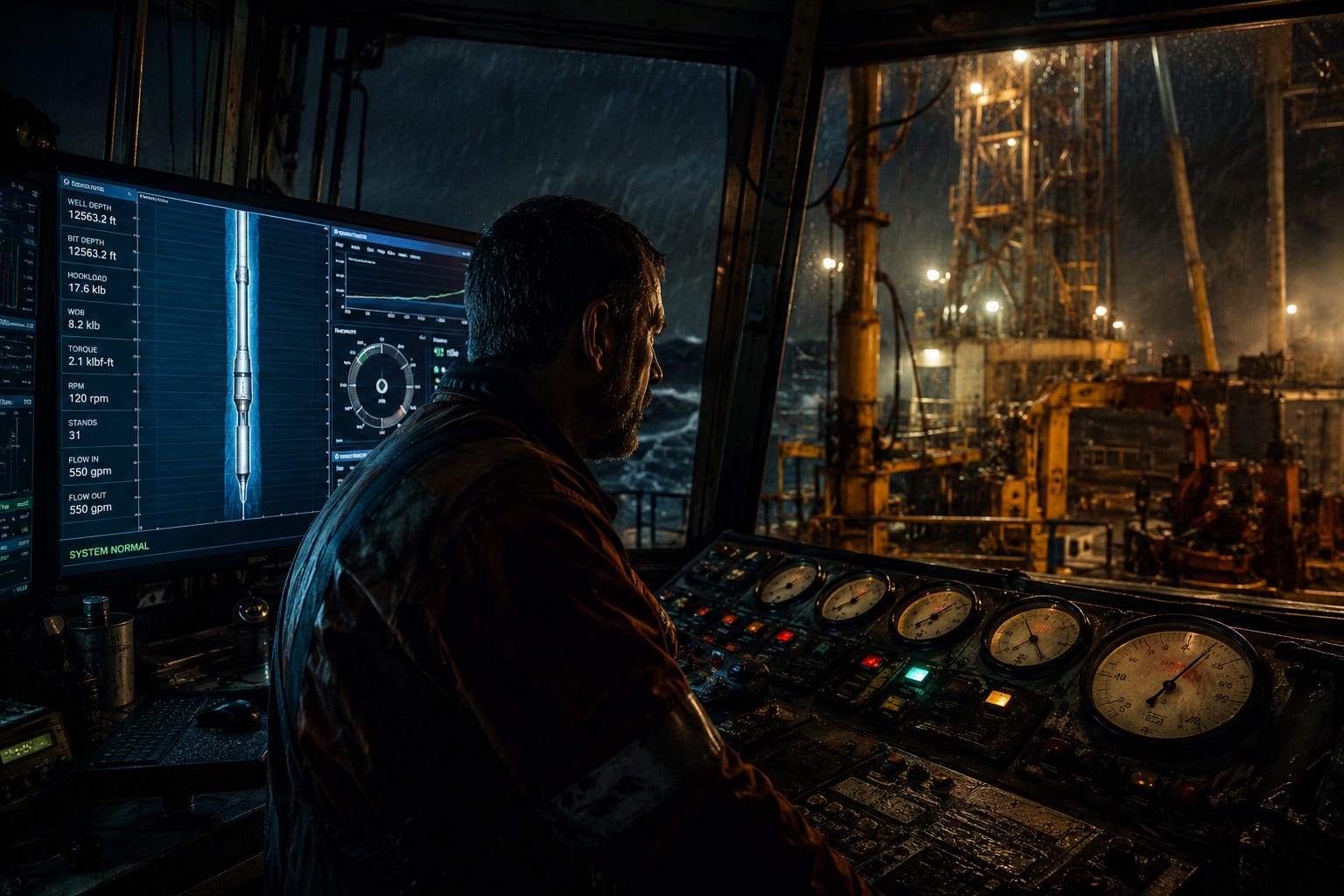
The downhole representation updated smoothly every few seconds. The packer appeared exactly where it was supposed to be. Torque looked stable. Pressure trends looked clean. According to the software, the operation was behaving almost perfectly.
Then the floor shook. The string was stuck.
And within seconds, the confidence of the model started feeling detached from reality. The pressures on the manual gauges did not line up with the digital readout at all. The well was clearly behaving differently from what the software believed was happening downhole.
We spent the next eighteen hours fighting a physical system that the model had failed to understand.
I think about that moment a lot when I hear people talk about AI agents taking over industrial operations.
Because the uncomfortable truth is that many of the operational systems we built over the last decade were never designed for machine intelligence in the first place.
They were designed for us.
The Great Industrial Cleanup
For years, industrial companies invested heavily in digital twins, unified operational models, centralized telemetry systems, and visualization platforms. The logic made sense at the time. Build the digital foundation now, and eventually automation and AI will sit on top of it.
But in hindsight, we optimized those systems around human readability more than operational truth.
We cleaned the data relentlessly.
Tiny pressure spikes were filtered out because they looked noisy. Sensor drift got corrected away. Strange transient behavior was smoothed over because operators and executives both prefer systems that appear stable and predictable.
And honestly, that worked reasonably well for dashboards.
Humans need simplification to make decisions quickly. Nobody wants a control room interface that constantly looks chaotic. Nobody wants to explain messy telemetry during an executive review.
So we built systems that reduced ambiguity.
The problem is that ambiguity is often where the operational truth actually lives.
AI Does Not Think Like an Operator
Experienced field operators develop intuition through exposure to inconsistency.
They remember the pump that vibrates differently during humid weather. The compressor that only behaves strangely during startup after maintenance. The well that technically stays inside operating limits while quietly drifting toward instability over several days.
Most of that knowledge never makes it cleanly into enterprise systems because it is difficult to structure and difficult to explain.
But humans notice patterns through repetition. Through scar tissue. Through accumulated exposure to things behaving badly.
AI systems work differently.
They do not build instinct the way operators do. They depend entirely on the fidelity of the data environment around them.
And if the operational history has been aggressively cleaned, filtered, averaged, and normalized, the AI ends up learning from a version of reality that barely resembles the physical system itself.
That is the part I think many industries are only beginning to realize.
By trying to make industrial data easier for humans to consume, we may have accidentally removed the exact signals modern AI systems need most.
Sanitized Telemetry Creates Fragile AI
A surprising number of industrial AI discussions still assume the problem is model sophistication.
Bigger models.
Better copilots.
More agents.
Cleaner orchestration layers.
But many operational failures are going to come from something much simpler: the underlying telemetry no longer reflects the full behavior of the system.
An AI agent trained on idealized operational data can look remarkably competent right up until reality moves outside the cleaned boundaries of the model. And unfortunately, industrial systems spend a lot of time outside ideal conditions.
Pumps age.
Sensors drift.
Operators improvise.
Assets behave differently in summer than winter. Equipment responds differently under partial loads. Small maintenance shortcuts compound over time in ways that rarely appear inside clean enterprise datasets.
The physical world accumulates history. Most industrial software tries to suppress it.
That gap becomes dangerous once AI starts participating in operational decision loops instead of just generating recommendations for dashboards.
The Next Industrial Rebuild
I do not think this means digital twins were useless. Far from it. Many created enormous operational value.
But I do think the assumptions underneath them are changing very quickly.
The next generation of industrial AI systems will probably require a very different data philosophy. Less emphasis on polished representations. More emphasis on preserving raw operational behavior, even when it looks uncomfortable or difficult to interpret.
Messier systems.
Higher-frequency telemetry.
More tolerance for contradiction and uncertainty.
Ironically, the operational data that companies spent years trying to clean up may become some of the most valuable data they own.
And that creates a difficult question for the industry because rebuilding operational infrastructure around machine reasoning instead of human presentation is not a small adjustment. It changes how systems are architected, how telemetry is stored, how operators interact with software, and even how companies think about reliability itself.
That is a much bigger shift than simply adding an AI layer on top of existing systems.
What Happens When AI Meets Reality?
I still think back to that offshore job sometimes because it exposed something fundamental.
The software was not malicious. The engineers were not incompetent. The model simply reflected an idealized version of the operation while the well itself kept evolving in real time.
Reality moved faster than the representation.
A lot of industrial AI may be heading toward the same collision.
The companies that adapt fastest probably will not be the ones with the cleanest dashboards or the most impressive demos. They will be the ones willing to expose their AI systems to the messy, inconsistent, high-friction nature of real operations instead of hiding it behind polished abstractions.
Because eventually every industrial system encounters the same thing we did offshore that night: the moment when the model says everything is fine, but the floor starts shaking anyway.