
AI-native Digital Twin - Colo Data Centers
What Digital Twins Do, What They Don’t, and What Agentic AI Actually Changes

Turing Pilgrim crossed 100 subscribers this week. Not a huge number. Still, it makes me genuinely happy that people are finding value here.
Special shout out to Jurgen Appelo for recommending the page and being an early supporter. That kind of support matters more than you think.
If you’re one of the 100, thank you. If you’ve shared a post, replied, or just read quietly in the background, I see you. Onward.
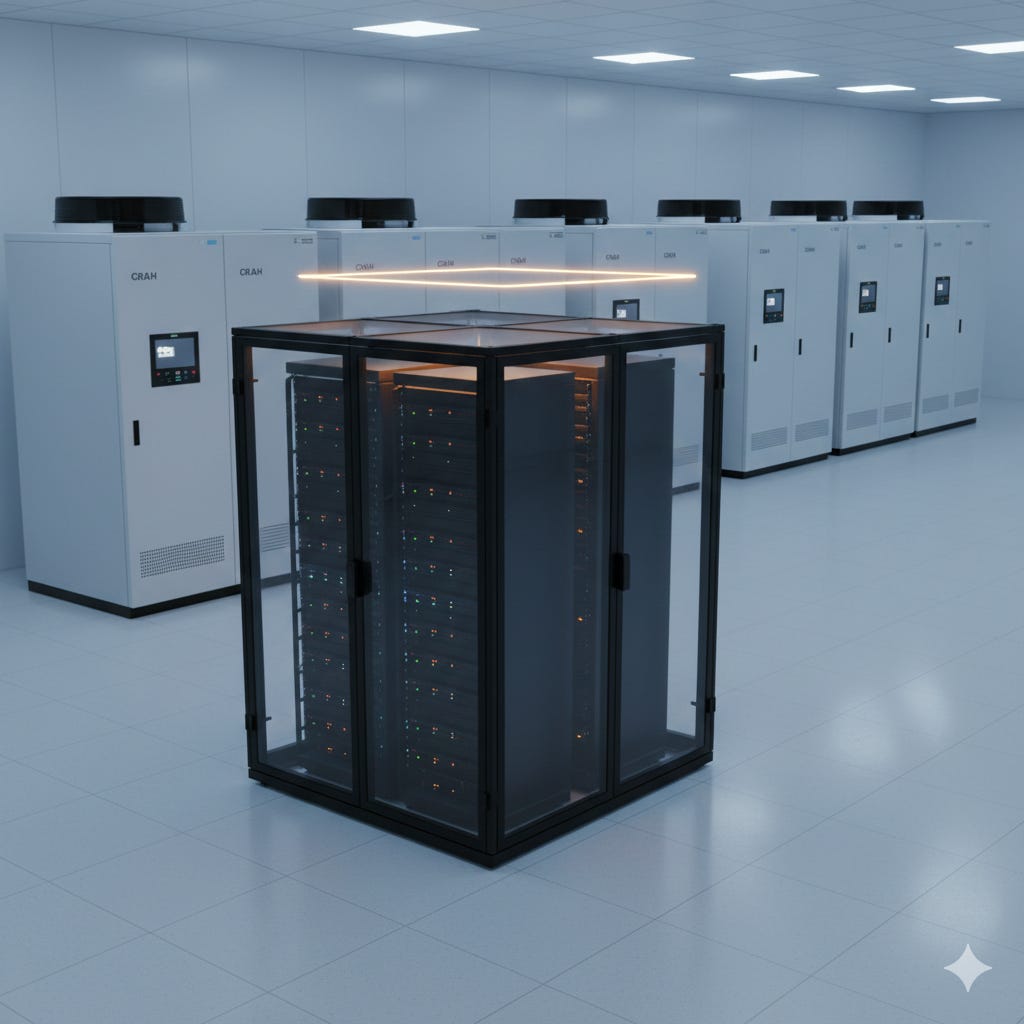
If you strip away the abstractions, a colo operator lives inside a small box: temperature, humidity, availability, and the cost of staying within those bounds.
That’s the real operating constraint. Not global PUE dashboards or campus-wide efficiency targets, but whether a specific cage remains inside SLA while energy spend stays defensible.
AI workloads have made that box tighter. GPU clusters ramp abruptly, draw dense power, and concentrate heat in ways that steady enterprise workloads rarely did. When a cage begins trending warmer than expected, nothing dramatic happens. There are no alarms, no red lights. Fan speeds increase slightly. Chilled water valves open a bit more. Humidity shifts as thermal gradients adjust. You remain within SLA, but the system works harder and the energy bill shoots upward.
The Physics Behind the Margin
At cage level, the thermodynamics are not complicated, but the implications are expensive. Heat removal depends on airflow mass and temperature differential.
Q - Heat Energy (or Heat Removed)
m - Mass of Air Moving Through the System
c - Specific Heat Capacity of Air
ΔT - Change in temperature
As compute density rises, you either increase airflow or adjust the temperature differential to remove the additional heat. The relationship feels manageable until you look at how cooling power scales. Fan energy increases roughly with the cube of airflow velocity.
P - Fan power consumption (typically in kW)
v - Air velocity (or more precisely, proportional to fan rotational speed)
That cubic scaling is where costs accelerates. A modest increase in airflow to preserve an extra degree of safety margin can have a disproportionately large impact on power draw. When multiplied across dozens of cages, that margin becomes a meaningful operating expense.
Which reframes the question. The real issue is not whether you are inside the SLA band. It is how far inside you need to be.
What Digital Twins Do Well Today
Most digital twins are built to answer the first question reliably. They ingest telemetry from BMS (Building Management Systems) and DCIM (Data Center Infrastructure Management) systems, track rack-level temperature and humidity, map airflow zones, and simulate redundancy scenarios. If temperature crosses 27°C, you know. If humidity drifts out of band, you know. If a CRAH (Computer Room Air Handler) fails and redundancy degrades, the system can simulate the new steady state.
These tools are strong observers. They provide clarity and guardrails. For years, that was exactly what operators needed. Workloads were smoother. Growth was predictable. Running three degrees below the SLA ceiling felt prudent and inexpensive relative to risk.
In that environment, the twin’s job was observation & confirmation.
Where the Model Thins Out
AI density changes the shape of the problem. Load is no longer smooth. It spikes and oscillates. It behaves more like weather than plumbing.
Most digital twins remain deterministic. If load increases by X, temperature rises by Y. If a component fails, the model predicts a new equilibrium. That logic works well for design validation and failover planning, but it struggles with burst behavior and probabilistic risk.
What these systems rarely provide is a distribution of outcomes. They do not easily answer: given current volatility, what is the likelihood this cage exceeds SLA within the next ten minutes? How sensitive is that risk to a one-degree change in setpoint? How does tightening humidity control affect both excursion probability and energy spend?
There is also the matter of drift. Commissioning assumptions rarely remain perfectly accurate. Containment degrades slightly. Rack layouts evolve. Customer densities change airflow patterns. Telemetry updates continuously, but the underlying behavioral model often remains anchored to its original design logic. Over time, the gap between expected and actual response can widen.
The twin still reflects the building. It does not always evolve with it.
Availability Is About Time, Not Just Redundancy
Availability is often discussed structurally through N+1 cooling or 2N power. Yet at cage level, availability is dynamic. If a cooling unit fails during a high-density workload, the critical variable is not simply whether redundancy exists, but how long before the cage drifts beyond SLA.
Time-to-excursion becomes the core metric.
Traditional twins can simulate the failure event. Fewer quantify how sensitive that outcome is to real-time load volatility and operating setpoints. The difference between running one degree below SLA and three degrees below may materially change that time window. Without probabilistic modeling, operators default to conservative buffers.
BUT conservatism comes with a cost.
What AI Actually Changes
AI does not alter thermodynamics. It changes what can be simulated, recalibrated, and reasoned about continuously.
Instead of binary threshold alerts (think rule based), AI-enhanced systems can estimate excursion probabilities. Instead of fixed fan curves, they can evaluate alternative control policies across thousands of micro-scenarios. Instead of assuming commissioning airflow models remain static, they can adjust parameters based on live telemetry as the building’s behavior drifts.
This enables a different kind of question. If we allow this cage to float up to 26.5°C during low-volatility periods, how much energy do we save? What does that do to excursion probability under a sudden GPU ramp? How does a slight widening of humidity band affect both cost and availability risk?
The conversation shifts from “Are we safe?” to “How tightly do we need to hold the margin?”
That shift is subtle but meaningful. Temperature, humidity, and availability cease to be purely engineering constraints and become economic tradeoffs.
The Cultural Constraint
There is, however, a cultural wall.
Digital twins today are trusted because they are conservative mirrors. They observe and enforce boundaries. The moment they begin advising how close to operate to those boundaries, they become part of the decision. If a cage crosses SLA during an optimization experiment, the explanation will not cite probability distributions. It will cite failure.
Trust in physics modeling, data integrity, and probabilistic reasoning must precede any meaningful narrowing of margin. And trust accumulates slowly.
Which means the technological capability may arrive before the organizational appetite does.
Where This Leaves Us
Digital twins today are strong observability platforms. They provide visibility, simulate deterministic outcomes, and enforce guardrails. What they do not yet consistently provide is quantified reasoning about cost and risk at cage level under volatile AI workloads.
AI makes that reasoning technically feasible. It does not make it culturally inevitable yet.
So the question isn’t whether digital twins are useful. They clearly are. The more interesting question is whether we are ready to let them influence how much safety margin we truly carry.
And increasingly, that is where the core optimization problem lives.