

Ambient AI
Infrastructure Disguised as Convenience

When Samsung announced last week its “AI Home” vision at IFA 2025, the headlines leaned into a single idea: AI is moving into the background. No chatbots, no prompts, no glowing UI. Just algorithms quietly shaping how your home runs, your phone behaves, and your appliances save energy.
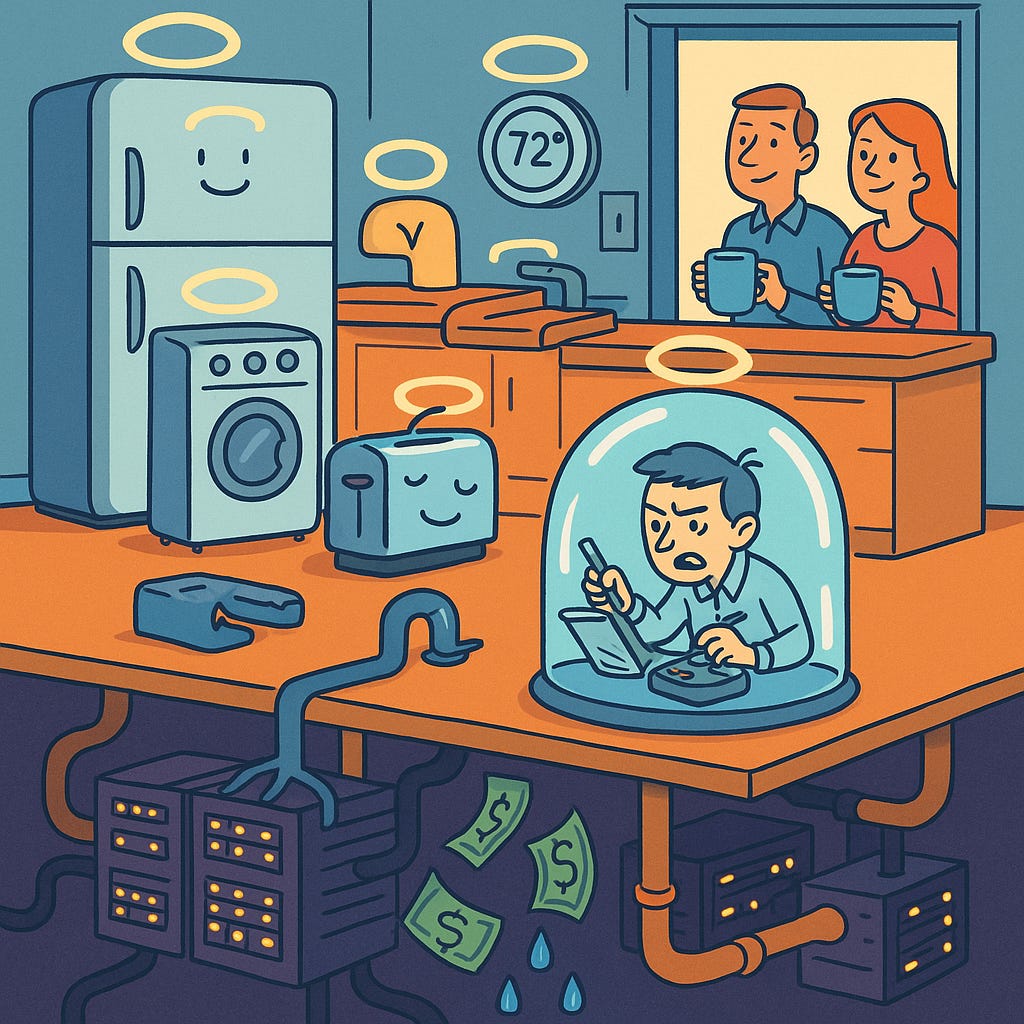
This shift deserves attention. Because whenever technology disappears from view, it often means the costs, trade-offs, and power dynamics are being hidden too.
What Ambient AI really is
Ambient AI is AI so deeply embedded into systems that you don’t have to ask for its help.
Your phone tweaks a photo automatically. Your washing machine adjusts the water cycle on its own. Your thermostat learns your routine and shifts energy use without you ever opening an app.
At IFA 2025, Samsung put this vision front and center. The company said 66% of consumers find an AI-enabled home appealing, and it’s leaning in with features like AI Wash+ in washing machines and dishwashers that adapt cycles based on dirtiness, plus SmartThings Energy tools that can cut washing machine energy use by up to 70% in certain cases.
By the end of 2025, Samsung expects to bring Galaxy AI to 400 million devices worldwide. The impact is significant.
This is a big pivot. We started with AI that sat front and center — chatbots, copilots, visible tools. Now the industry wants AI to fade into the wallpaper. From apps you use to systems you live inside.
Reactive vs. Proactive
Almost all consumer AI today is reactive:
You type a prompt into ChatGPT.
You ask Alexa to play a song.
You click “generate” in Photoshop.
The AI waits for you to act.
Ambient AI flips that. It is designed to be proactive:
It monitors context through sensors, usage patterns, and routines.
It makes adjustments without you asking — dimming the lights, optimizing battery use, lowering thermostat before peak pricing hours.
The goal is to anticipate rather than respond.
Reactive AI = I ask, it answers or acts.
Ambient AI = It notices, it decides, it acts.
That distinction matters. A reactive system feels like a tool. A proactive one becomes part of the environment.
Why companies want it ambient
There’s a reason this shift is happening now. Consumers are fatigued by the AI hype cycle. Few want to wrestle with a dozen new interfaces or prompts. Ambient AI promises something cleaner: no diversions, just making life easier.
But I don’t think this is only about convenience. To me, ambient AI is also a business strategy.
Lock-in: If AI quietly runs across your phone, fridge, and home, leaving Samsung (or Apple, or Amazon) means leaving the assistant that makes it all work. My sense is that switching becomes painful by design.
Efficiency narrative: Samsung is highlighting sustainability — smarter appliances, optimized energy, reduced waste. It’s a strong marketing pitch, especially when paired with survey data showing broad consumer interest.
Platform stickiness: Once ambient AI feels like infrastructure — like electricity or Wi-Fi — it’s no longer optional. Companies want to own that baseline.
And the market data backs this up. The ambient intelligence market is projected to grow at roughly 24–25% a year, expanding nearly sevenfold this decade. That’s not hype — that’s a massive economic shift in progress.
The hidden costs
Here’s the first aha: Ambient doesn’t mean free.
Every quiet algorithm humming in the background still depends on energy-intensive models running somewhere. Even when inference is pushed to the edge device, those models had to be trained on clusters the size of small power plants. I can’t help but think about the hidden trade-offs: that washing machine marketed as saving 70% energy on a cycle still sits atop a global stack of datacenters, chips, and supply chains.
And energy isn’t the only hidden cost:
Surveillance: Ambient systems mean more continuous data collection. If your devices are optimizing all the time, how much are they recording? When? What?And who sees that data?
Labor: Behind automation are human workers — annotators, moderators, maintenance crews — whose jobs remain invisible by design.
Accountability: if AI makes a decision I never even noticed, who exactly should be held responsible when it goes wrong?
And the infrastructure pressure is real. In the U.S., datacenter electricity use could triple by 2028, rising from around 4% of national consumption today to as much as 12%, largely driven by AI workloads. That’s the hidden cost (& opportunity) beneath the efficiency narrative.
Here’s the second aha: The quieter the AI, the harder it is to question. Transparency doesn’t vanish because there’s nothing to see. It vanishes because the system was designed to avoid drawing attention in the first place.
The infrastructure behind the curtain
Ambient AI at home only exists because of very visible industrial infrastructure. Chips fabricated in Taiwan or South Korea. Assembly lines in Vietnam and China. Logistics networks that stretch across oceans. Energy grids straining under the weight of new datacenters.
This is the third aha: Consumer AI is getting smaller, but its footprint will get bigger.
My view is that when AI becomes ambient in your life, its true scale is only more global. It’s the chip wars between the U.S. and China. The grid interconnection queues delaying datacenter builds in Texas and Virginia. The water battles in Arizona where AI datacenters compete with farmers for groundwater.
The less you notice AI in your daily life, the more it is shaping policy, energy markets, and geopolitics.
A shift from tool to environment
There’s another dimension here — social, not just technical. When AI is visible, you can choose whether or not to engage. You open ChatGPT. You ask Siri. You use a copilot in Excel.
But when AI becomes ambient, it stops being a tool. It becomes an environment. Something you don’t think about until it fails.
We’ve already imagined what that looks like. The Black Mirror episode “White Christmas” took it to the extreme: a person’s consciousness copied into an AI, condemned to run a household as an ambient assistant. What made it chilling wasn’t the tech itself — it was how natural it seemed. The AI wasn’t asked for input, it simply became the environment, a ghostly infrastructure no one noticed until it suffered or broke.
That’s convenient, yes. But to me it also reduces our ability to notice when systems are drifting, when biases creep in, when choices are made for us instead of by us.
Here’s the fourth aha: Ambient is a strategy, not just a feature. By disappearing, AI sidesteps scrutiny. It feels natural, unquestionable, inevitable.
Why it matters now
Why spend a whole essay on a marketing announcement? Because the direction of travel is clear.
Samsung’s announcement is just one signal in a broader pattern. Google, Apple, Amazon, and Meta are all pushing ambient intelligence. Device makers and platform companies are trying to turn AI into background radiation — always there, rarely noticed.
That makes it infrastructure. And once something becomes infrastructure, it shapes society in ways that are hard to roll back. Think of electricity, highways, or broadband. Once it’s there, it rewires how economies and communities function.
Ambient AI is heading the same way. It won’t just be in phones and fridges. It will be in offices, cars, city grids, and supply chains. It will feel like it was always there. Which is exactly why, in my view, this is the right moment to pay attention.
Closing
The ambient AI pitch is seductive: effortless convenience, efficiency, sustainability. But in my view, nothing ambient comes free. Someone, somewhere, is paying the costs in energy, labor, or transparency.
The question is whether we’ll let those costs stay hidden.
Because once AI disappears into the background, its impacts on privacy, power and transparency only grow larger. If AI is to become an ambient atmosphere around us, we’ll need to work harder to make sure its consequences remain visible and accountable.
