

Part 3: Physical AI
Why the boring robots are the ones that will actually change your life.

If the Agentic Shift represents the brain of the next economy, then robotics serves as the hands. For decades, the promise of robots was a recurring trope of science fiction that failed to materialize in daily life. 2025 changed that perception. We stopped watching robots perform backflips for social media or sort parcels in warehouses and started watching them load the dishwasher and sort through vegetables in the kitchen.
Though task specific robots have been around for a while, such as those used in automobile assembly lines; those that can be more general purpose finally seem to be on the horizon.
The transition from lab novelty to operational dependability will be the defining characteristic of 2026. This is the year when Physical AI reaches enterprise scale. Physical AI refers to artificial intelligence that enables machines to autonomously perceive, reason about, and interact with the physical world in real time. We are moving past the era of rigid, pre-programmed machines. We are entering the era of adaptive systems that learn from their environment and perform tasks without a script.
Lens 1: Immediate Impact (The End of the Lab Novelty)
The most visible change in the early days of 2025 was the arrival of foundation models in robotics. In the past, every robotic movement had to be painstakingly coded by hand. If the lighting changed or an object was slightly out of place, the robot failed. 2025 broke that cycle through the emergence of multimodal vision-language-action (VLA) models. These models integrate computer vision, natural language processing, and motor control; this allows robots to interpret their surroundings and select actions much like the human brain.
These models allow robots to adopt training methods similar to large language models. Instead of learning a single task, they gain a broad base of understanding that integrates multiple sensors. A command like “pick up the red mug” is no longer a sequence of coordinates. It is a semantic goal that the robot interprets and executes based on its real time perception of the environment. Intelligence is no longer confined to the software: it is embodied in the hardware.
This shift has enabled robots to go narrow and deep in specific industries. While general purpose humanoid helpers for the home are still in the pilot verification stage, robots in logistics, manufacturing, and services have moved into full production. We see autonomous pallet jacks loading cargo and humanoid robots performing fine motor movements in warehouses.
Companies like Agility Robotics and AGIBOT have produced thousands of units already deployed in commercial environments.
This progress is supported by initiatives like the Open X-Embodiment project, which has aggregated data from over 20 different robot types to improve generalization.
The immediate impact is a move away from automation theatre toward reliable infrastructure. Businesses are skipping the headlines: and instead seeking tangible customer benefits. Large scale deployments, such as Amazon deploying its millionth robot, show how DeepFleet AI can coordinate entire fleets.
2026 is where you see general purpose robots move beyond the lab, driven by advancements in sensing and low power and distributed compute that make autonomous deployment practical at scale.
Lens 2: Geopolitics (The Labor Replacement War)
The rise of physical AI is not merely a technological race. It is a geopolitical imperative driven by demographic collapse and labor shortages. In 2025, the labor crisis in manufacturing reached a breaking point, particularly in the United States where more than one million manufacturing jobs remained open. Automation became the only reliable way to maintain domestic production levels without igniting wage inflation.
China currently dominates this landscape, accounting for more than 50% of global industrial robot deployments. To counter this dominance, Western manufacturers are under immense pressure to localize their production and reduce reliance on Chinese components. In 2026, we are seeing a formal split in the robotics ecosystem. A gradual divide between US-aligned and China-aligned robotics ecosystems is emerging. While this split raises short term costs, it might improve long term resilience.
This split is about tech sovereignty. If your factory runs on a robotic fleet with a foreign brain and foreign sensors, you do not fully own your industrial base. Governments are now treating robotics as a national priority asset class, with the United States considering stand-alone executive orders to support a domestic robotics champion class. Trust-by-design standards are being implemented to ensure that these physical agents are verifiable and safe in sensitive operational environments.
Reshoring used to mean retraining. Robotics breaks that link. With Physical AI, factories can return without waiting for the workforce to relearn the work.
At the same time, robotics is becoming a tool to accelerate re-shoring. To remain competitive with lower cost economies, manufacturers in high wage countries are increasingly turning to automation to boost output per worker. This is not about saving money on labor costs alone; it is about turning an AI lead into physical output. Robotics is being elevated from a footnote to a pillar of national strategy.
Lens 3: The Compounding Effect (The Substitution Era)
This brings us to the most difficult part of the transition. We are moving from automation to substitution.
Automation removes tasks; substitution replaces roles.
While many organizations claim that technology is merely a partner to human labor, the reality in 2026 will be that AI is graduating from a productivity tool to a labor substitute

Substitution is about roles that involve coordination and basic judgment. We are seeing middle management compression as agentic workflows and robots take over functions like customer service, bookkeeping, and warehouse management. In some cases, companies are choosing not to backfill roles, consolidating teams, and automating first-layer support.
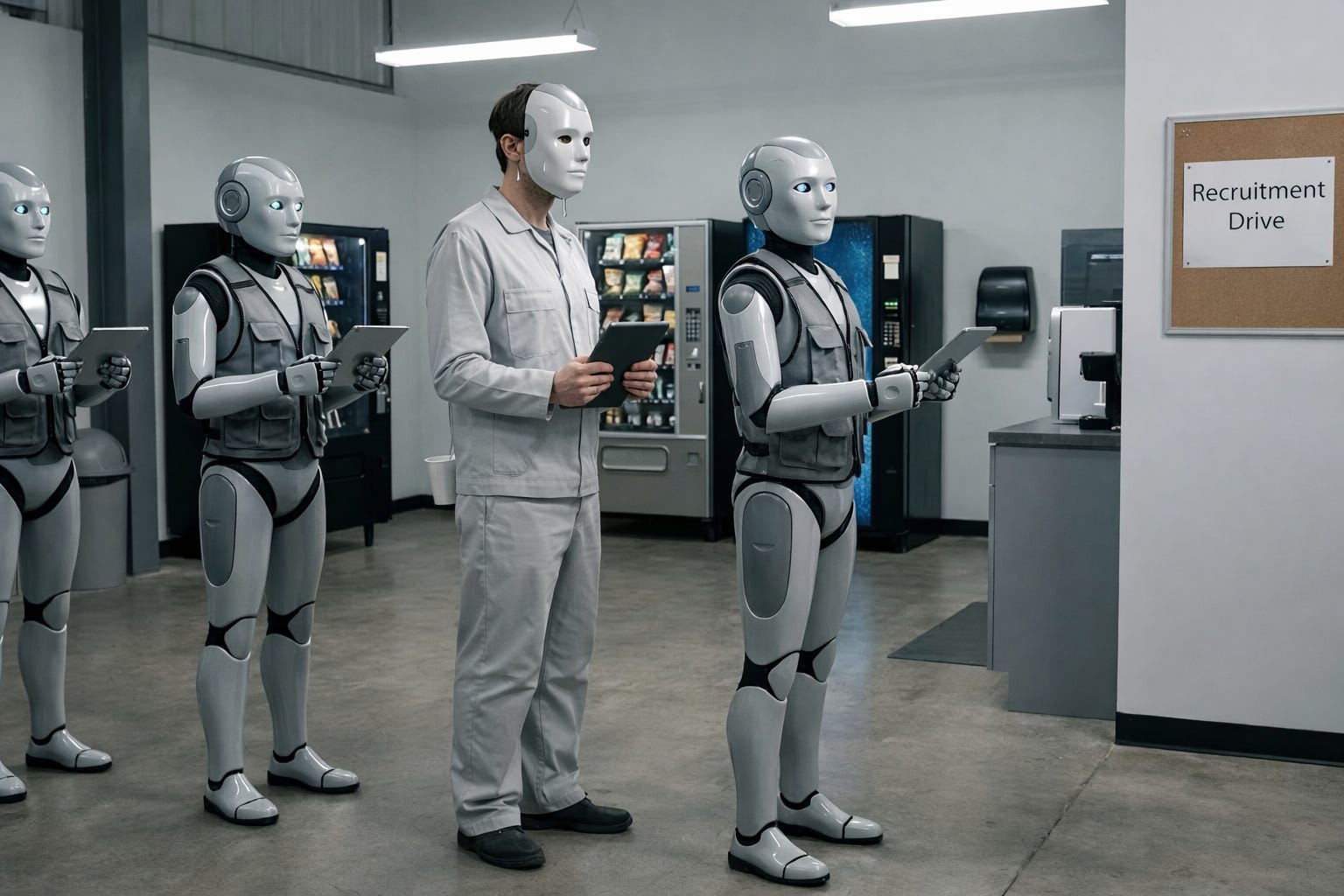
This is the vibe of 2026: the great productivity harvest.
The economic results are becoming bifurcated. GDP remains strong as AI-driven productivity allows the economy to produce more output with fewer workers. However, this creates a two-speed economy where capital owners and those who can direct AI thrive, while task-based workers struggle with skills mismatch and job displacement.
There is also the arrival of true 24/7 lights-out operations. Some operators are already running night shifts where robots handle all core workflows without on-site human supervision. This hybrid model, with robots running lights-out for part of the day, is set to expand rapidly in 2026. It changes how organizations remember. Every action taken by a human operator is being digitized and used as training data for the next generation of physical AI; this means workers are inadvertently training their replacements.
When coordination lives in the agentic layer, the why behind a choice is technically recorded but socially absent. We are creating a generation of exception handlers who do not understand the underlying rules because they no longer perform the mundane tasks where those rules are learned.
Uncertainty will be the constant of 2026
We have spent this series walking through the quiet maturity of 2025 and the expected inflection point of 2026. We have seen how the Agentic Shift is moving us from dialogue to delegation. Now, we see how Physical AI is giving that intelligence a body to act in our world. Intelligence is increasingly moving onto local devices and robots, powered by energy-efficient system integration.
These systems are no longer science projects: they are commercially viable imperatives.
This begs the question: How do you see robots becoming more than just a sci-fi trope?
As we move toward a world of sovereign agents and robotic substitution, the answer to that question will define our relationship with technology for decades to come. We have built an incredible infrastructure of intelligence but the range outcomes is wide open.