

Part 4: Weeks to Forever
How AI Scale forces the shift from storage to generation

In Part 1, the enemy was instability. We fought it with milliseconds.
In Part 2, the enemy was congestion. We fought it with hours.
In Part 3, the enemy was isolation. We fought it with days.
At some point, fighting time stops making sense. This is that point. Weeks are not a storage problem. They are a generation problem and this is where the conversation shifts from batteries to power plants.
In Part 4, the enemy is constraint.
The Misunderstanding: This Is Not About Going Off-Grid
Let’s clear something up immediately.
The goal is not to disconnect from the grid and pretend you are an island.
The grid is still the cheapest balancing machine ever built. It gives you liquidity. It gives you redundancy. It gives you optionality. Walking away from that is irrational.
Right now, the constraint on AI growth isn’t total national generation capacity. The U.S. produces more than enough electricity in aggregate. The constraint is local (I may have mentioned this before).
Transmission upgrades. Substation capacity. Permitting queues. Multi-year capital plans. If your next 300 MW campus is waiting on a four-year transformer upgrade, your competitive timeline is now dictated by someone else’s infrastructure roadmap.
That’s the bottleneck. So what happens if you bring 150 MW of generation with you?
You rebalance the relationship.
You recharge when prices are low.
You discharge when prices spike.
You lean on the grid for stability.
But your expansion plan no longer waits in line. That’s the mental shift.
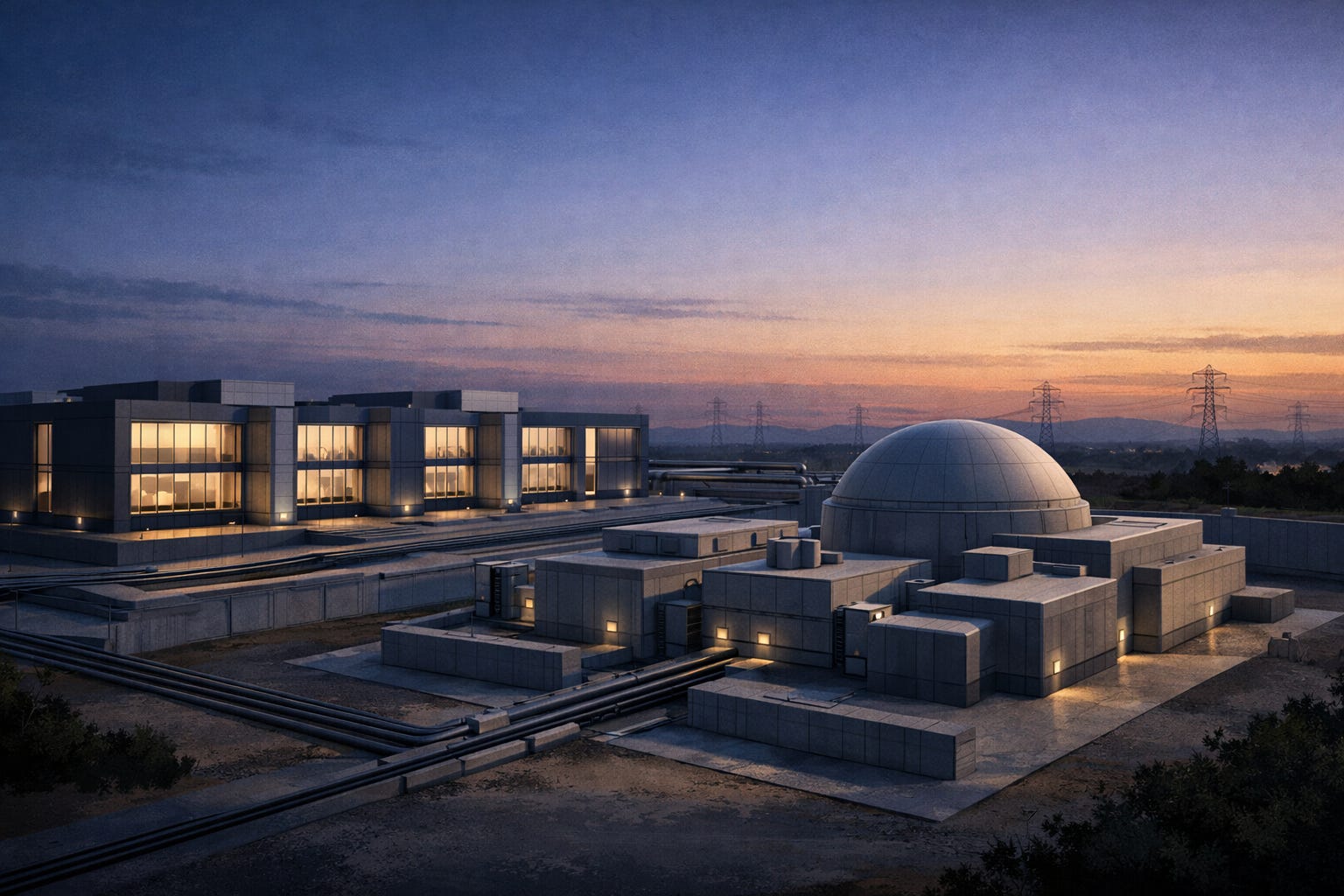
When Data Centers Become Heavy Industry
We will soon stop pretending data centers are just commercial real estate with better cooling. They are heavy industry. Historically, energy-intensive industries did not passively wait for utilities to accommodate them.
Aluminum smelters built dams.
Steel plants built rail spurs.
Refineries built pipelines.
AI hyperscalers are starting to behave the same way. This behavior will define the next decade of AI infrastructure.
The Technologies of “Forever”
Once you decide to generate on-site, you leave the world of electrochemistry and enter thermodynamics.
There is a timing reality here. Batteries are still the fastest way to get a site live. As we saw in Part 2, they hack the interconnection queue and flatten the peak. If you need compute online in 18 months, you buy batteries.
But batteries only solve the power constraint. They do not solve the energy constraint.
Before we look at the heavy metal, let’s address the elephant in the room: Renewables. You might notice solar and wind are missing from the primary list below. That is intentional.
Renewables are part of the mix. They are the cheapest electrons you can buy. But in the context of autonomy, they are not a 100% reliable.
If you need 500 MW of firm power 24/7 to train a model, and you rely solely on solar, you need 2,000 MW of panels and a mountain of batteries. That brings us right back to the storage scaling problem we hit in Part 3.
So yes, build solar. Cover the parking lot. Lower your effective cost per megawatt. But do not confuse it with the firm generation required to act as a utility. For that, there are three practical paths emerging.
1. The Pragmatist’s Path: Behind-the-Meter Gas
The most scalable way to deploy 300 to 500 MW of firm, dispatch-able power is not solar plus batteries. It’s a gas pipeline. Combined cycle gas turbines are quietly re-entering campus designs. Not as backup. As primary generation. The logic is simple. Gas technology is mature and has the highest energy density with a quick on/off button.
It isn’t instant. Permitting a turbine takes time (and let’s not forget supply chain issues). But unlike a grid upgrade, the timeline is largely under your control. The trade-off is obvious. Carbon.
For operators facing five-year interconnection delays, that trade-off looks manageable. Especially if offsets or renewable credits can balance the ledger elsewhere.
Is it elegant? No.
Is it practical? Very.
2. The Industrial Middle: Fuel Cells
Solid oxide fuel cells sit in an interesting space. The data center energy boom is rekindling interest in this oft overlooked energy source. They convert natural gas or hydrogen into electricity electrochemically rather than through combustion. Fewer moving parts. Lower noise. Cleaner local emissions.
They are easier to site near urban or suburban campuses. They scale modularly. You can stack megawatts without building a full turbine hall. They are more expensive per megawatt. But they offer something gas turbines do not.
Densification.
You can bring serious baseload generation closer to the load itself. For dense AI campuses, that matters.
3. The Long Bet: Nuclear and Geothermal
Then there’s the horizon.
Small Modular Reactors.
Enhanced geothermal systems.
This is the “Weeks to Forever” layer in its purest form. A factory-built reactor delivering hundreds of megawatts for decades. A deep geothermal well producing constant baseload independent of weather or fuel supply chains.
The appeal is obvious.
Energy density.
Carbon neutrality.
Multi-decade certainty.
The reality though is that this route is MUCH MUCH slower. Regulatory frameworks are still evolving. Supply chains are still maturing. Public acceptance is uneven. But the conversation is no longer theoretical. AI load growth is forcing it into boardrooms.
When compute demand scales exponentially, nuclear starts to look less extreme.
Why Storage Stops Scaling
At some duration threshold, storage becomes irrational. If you are designing for two weeks of autonomy, you are not building a battery. You are building inventory. Massive capital tied up in assets that sit idle most of the year. Generation flips the math.
Instead of storing energy in advance, you produce it continuously. The capital intensity shifts from megawatt-hours to megawatts. From time shifting to source control.
That’s the structural difference between Part 3 and Part 4.
Part 3 was about surviving absence.
Part 4 removes absence as a constraint.
The Leverage Effect
When you control 100 MW on-site, your negotiation posture changes. You are no longer a load begging for capacity. You are a market participant.
You can design your on-site utility:
Export during scarcity.
Stabilize voltage.
Offer interruptibility.
Provide black-start capability.
The utility stops seeing a risk. They see an asset.
The Governance Question
If hyperscalers begin deploying gigawatt-scale generation behind the meter, what are they becoming? They won’t call themselves utilities. But functionally, they might resemble them. They will control generation, storage, distribution, and load management within a campus boundary.
That changes regulatory dynamics.
Who oversees reliability?
Who ensures safety?
Who governs exports back to the grid?
The line between private infrastructure and public utility begins to blur.
That tension will define the next chapter of energy policy.
The Throughline: Risk Reduction
We started this series with a UPS protecting a server across milliseconds. We end it with the likely scenario of a hyperscale campus hosting its own reactor. The thread connecting those two extremes isn’t chemistry.
It’s Risk Reduction.
In Part 1, you reduced instability.
In Part 2, you reduced volatility.
In Part 3, you reduced isolation.
In Part 4, you reduce dependence.
You aren’t building infrastructure because you want to be a utility. You are building it because relying on someone else’s capital plan is a risk, hyperscalers can no longer afford.
The grid is not collapsing and neither is its overall reliability BUT It is fragmented, localized, strained in some regions and overbuilt in others.
AI infrastructure is responding by industrializing. The advantage goes to those who realize early that energy is not just a commodity you simply procure but it is a risk you engineer out of the system.