

When AI Learns Physics...
...the Field changes

A machine is running hot. The vibration is drifting. The pressure response looks strange, and the dashboard is flashing an “abnormal” warning.
Okay. But abnormal how?
Is it fouling? Cavitation? Slugging? Bearing wear? A bad sensor? A control valve problem? Or is the asset simply operating in a regime the model has never really seen before?
That is the problem with a lot of industrial AI today. It can notice patterns, but it often cannot explain the physical story underneath them. And in the field, cycles are spent determining the story.
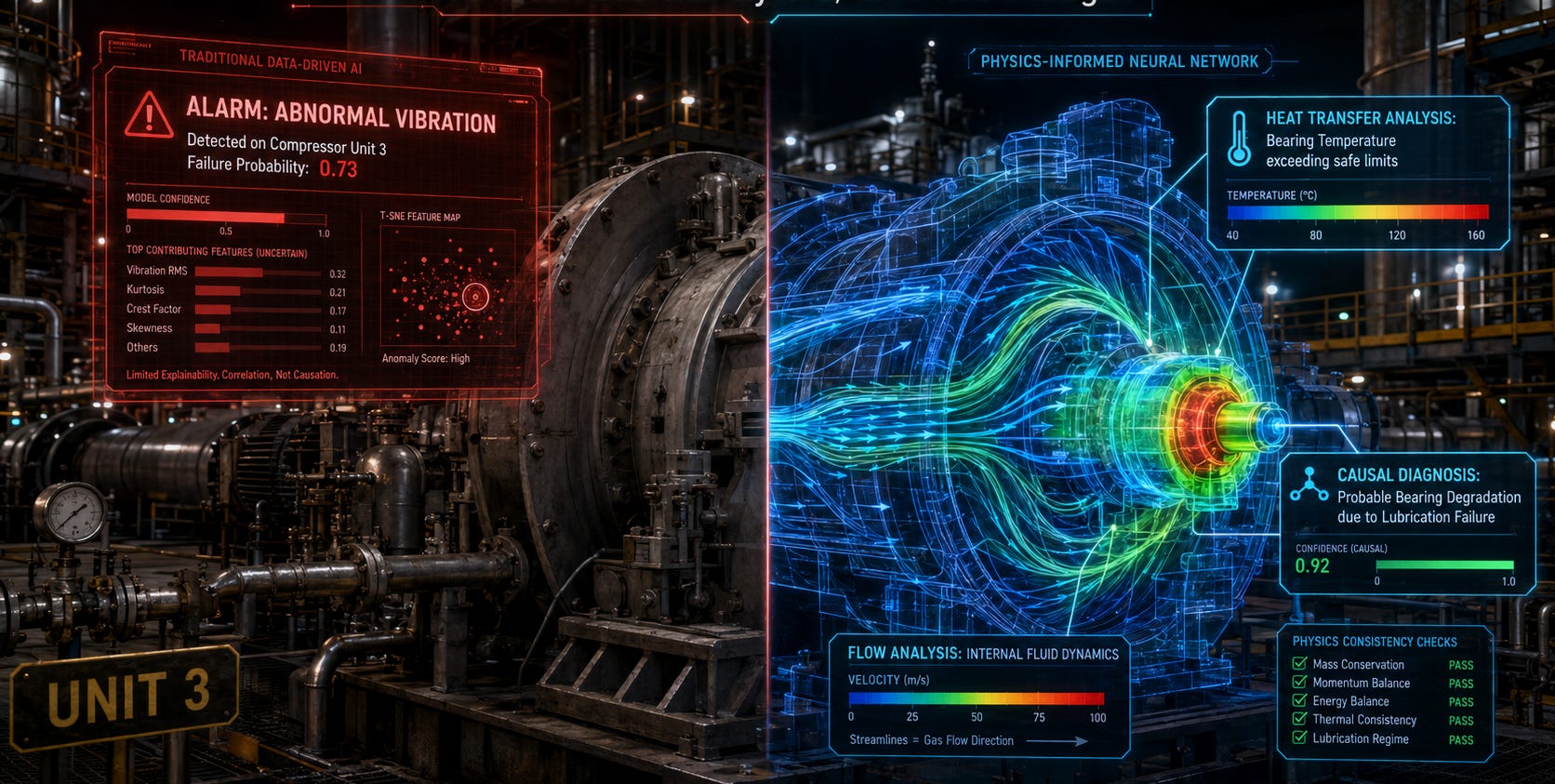
A compressor does not fail because a model score crossed 0.73. A pump does not cavitate because a dashboard turned red. A well does not become unstable because an anomaly detector got nervous.
Something physical happened. Mass moved. Energy shifted. Heat accumulated. Pressure changed. Material degraded.
So what happens when AI starts learning those physical rules too?
That is where physics-informed neural networks, or PINNs, get interesting. At a basic level, a PINN is a neural network trained with two kinds of discipline. It learns from data, but it is also penalized when its predictions violate known physics. Conservation of mass. Conservation of energy. Fluid flow equations. Heat transfer. Boundary conditions.
A normal model might say:
“This looks like a failure pattern.”
A PINN tries to say:
“This is the physically plausible state of the system that best explains what we are seeing.”
That difference sounds subtle. It is not. In fact, it could completely change how we bring AI into the field.
The As-Is State: Physics Lives in the Office, Operations Live in the Field
Today, industrial operations have a strange split. The physics is real, and everyone knows it is real. But most of the time, it lives somewhere else.
It lives in a CFD model built during design. It lives in a simulation run by a specialist. It lives in an Excel workbook or a vendor curve. Sometimes, it just lives in the head of the senior engineer who has seen this exact machine misbehave before.
Meanwhile, the field operator sees a fragmented picture. Pressure, temperature, vibration, flow rate, alarms, historian trends. Useful information, definitely. But the field is messy, and the model is clean.
That gap is exactly where many digital transformation programs die.
CFD is powerful, but rarely operational.
Computational fluid dynamics is one of the most impressive tools in engineering. We can simulate airflow, turbulence, combustion, and heat transfer. But CFD is notoriously slow. You define geometry, build a mesh, set boundary conditions, run the model, and wait. Then someone creates a slide deck.
That is valuable. But it is not the same as a field engineer standing beside an asset at 2:00 AM trying to decide whether to shut down, derate, or keep running. CFD today is often a photograph. The field needs a live feed.
Predictive maintenance sees patterns, but misses causes.
Most predictive maintenance systems today watch thresholds, detect anomalies, and estimate the probability of failure. This is useful, but there is a massive catch. Many of these systems are still just pattern machines. They know certain signals historically precede failure, but they rarely know why.
Imagine a dashboard saying:
“Failure risk high.”
The field supervisor asks:
“Why?”
In physical systems, the “why” determines the action. Bearing degradation, misalignment, and sensor drift can all produce ugly-looking signals, but they do not require the same response. A maintenance model that cannot separate symptoms from causes quickly becomes just another alarm in a noisy room.
Thermal management is becoming a front-line problem.
Thermal management used to feel like a design issue. Can the data center cooling design handle the load? Can the turbine remain inside its safe operating envelope? Now, heat is becoming a real-time operational constraint.
AI data centers are pushing rack density higher. EV batteries are charging faster. Industrial systems are optimized closer to their physical limits. And thermal problems rarely announce themselves. A hotspot can form where there is no sensor. The as-is state is fragmented again - design-time simulation over here, live sensors over there, and human judgment filling the gaps.
So How Do PINNs Actually Work?
Let’s avoid making this more mysterious than it needs to be.
A standard neural network is usually trained to minimize error against data. If it predicts 90 and the real answer is 100, it gets penalized. Over time, it learns patterns that reduce that error.
A PINN simply adds another kind of penalty. It says:
“You are not only wrong if you miss the data. You are also wrong if you violate physics.”
That is the key idea. A PINN might predict temperature or pressure across space and time
Then we check whether those predictions obey the equations we already know. For fluid flow, that might mean Navier-Stokes equations. For heat transfer, the heat equation.
The model’s training objective becomes a combination of errors:
Error against sensor data
Error against governing physics
Error against boundary and initial conditions
Error against known equipment constraints
That last part matters heavily because industrial data is rarely perfect. Sensors drift. Historians have gaps. The system is never as clean as the data science demo. Physics gives the model a backbone. It does not make the model perfect, but it narrows the range of nonsense.
And in the field, narrowing the range of nonsense is already a huge win.
The Core Shift: From Prediction to Physical Inference
Honestly, I think the biggest value of PINNs is not simply faster simulation. The deeper shift is that PINNs can help infer hidden physical states from limited observations.
You may only have a few pressure sensors on a pipeline, but pressure exists throughout the pipeline. You may only measure vibration at a few locations on a rotating machine, but degradation is happening inside the entire mechanical system.
The physical world is continuous. Our sensors are sparse.
PINNs try to bridge that gap. They use the sensor data we have, combine it with the physics we know, and estimate the internal state we cannot directly observe. They turn scattered readings into a physically coherent picture.
Where This Changes Industrial Operations
1. CFD Becomes Interactive
Instead of asking engineering to run a multi-day study, the field can use fast, physics-aware surrogate models trained by CFD. Operators can ask:
What happens if inlet temperature rises by 5°F?
What happens if we reduce fan speed by 10%?
The field doesn’t need a perfect CFD model every minute. It needs a fast, useful, physically grounded estimate to help make a better decision.
2. Predictive Maintenance Becomes Causal
A physics-informed model can go further than a basic risk alert. It can say:
“The observed vibration and temperature pattern is consistent with increasing imbalance and bearing degradation, not primarily a cooling issue.”
Maintenance is about deciding what to do next. Shut down? Derate? Inspect? Ignore a bad sensor? Physics gives the model prior knowledge about how machines are supposed to behave, and how they tend to fail, which is critical because actual failure data is thankfully scarce.
3. Thermal Management Becomes Real-Time
Imagine a PINN-based thermal model in a data center. It understands room geometry, airflow, heat generation, and energy conservation. Instead of just monitoring alarms, an operator can ask:
“Can we move more AI workload into this zone?”
And the system can answer:
“Yes, but only if fan zone 3 increases by 8% or supply air temperature drops by 1.5°C.”
That is not just monitoring. That is thermal reasoning.
4. Flow Assurance and Well Control Get a Live Companion
A well starts behaving strangely. Pressure is drifting. The choke response does not look normal. Maybe it is hydrate risk. Maybe slugging. Maybe an early kick.
A PINN-enabled system acts as a live physics companion. It continuously compares real-time well behavior against physically plausible states. The output isn’t a vague “pressure anomaly detected.” It sounds more like:
“Observed pressure behavior is consistent with early liquid loading. Hydrate risk remains low. If choke is opened by 8%, the model predicts unstable flow within 35 minutes.”
What a PINN-Enabled Product Could Look Like
Here is where I think this becomes a company, not just a research topic. Nobody in the field wakes up wanting to buy a physics-informed neural network. They want answers.
They want to know: What is happening? Why? How urgent is it? What happens if I wait?
The product shouldn’t be “PINN software.” It should be an operational intelligence layer for physical assets.
Connect the operational data: Ingest messy, real-world data from SCADA, historians, and IoT sensors.
Add the asset physics: Connect equipment geometry, operating envelopes, and failure modes.
Train the physics-aware model: Learn from historical data and physics constraints within a defined operational boundary.
Run live inference: Reconstruct the physical state of the asset in near real-time.
Convert physics into decisions: Tell the operator what is happening, why, what to check first, and the safest operating window.
Learn from the outcome: If the model predicts fouling and maintenance confirms it, the system gets smarter.
The Economic Case
The economic case for PINNs is not “AI is cool.” That won’t survive a budget review. The case is much more practical:
Reduce downtime: Intervene before a shutdown becomes unavoidable.
Improve maintenance timing: Move from calendar-based work to actual condition-based decisions.
Reduce energy waste: Detect inefficiencies like thermal loss or fouling early.
Extend asset life: Identify and avoid unfavorable operating regimes.
Make simulation operational: Turn expensive engineering simulation knowledge into daily, reusable operational intelligence.
What Could Go Wrong?
Let’s be honest. PINNs are promising, but they are not magic.
They can struggle with highly turbulent flows, chaotic behavior, and noisy sensors. Sometimes, traditional numerical methods are still just better. A PINN is not automatically superior to CFD or a well-calibrated control model.
The risk is overpromising. We have seen that movie before in industrial AI. The right starting point is narrower: Pick a bounded asset class. Pick a valuable failure mode. Pick a use case where physics is known, sensors are sparse, and decisions are expensive. Then prove it.
The World Before and After PINNs
The world before PINNs looks like this:
“We simulated the asset during design, and now we monitor it during operation.”
The world after PINNs looks more like this:
“The asset carries a live physics model of itself.”
That is the shift. Not every asset, and not immediately. But the direction is clear.
CFD becomes interactive. Maintenance becomes causal. Field teams finally get a way to connect what the sensors are saying with what the physical system is actually doing.
That is what excites me. It brings AI closer to the real world. Not the clean world of benchmark datasets, but the real one, the one with pressure drift, noisy sensors, aging equipment, and someone in the field asking:
“What do we do now?”